
Mapping the Delta, Made Simple
A New Online Resource for Delta Partners
March 25, 2026
By Dan Constable
When you think of the Sacramento-San Joaquin Delta, where do you picture its boundaries? Some may see it as part of a larger whole, an estuary and landscape that stretches from the upper watershed in the Sierra to the Pacific Ocean at the Golden Gate, and beyond. Others may think of the Delta in terms of a specific community or their favorite fishing spot. While all of these and many more make up the Delta, the Delta Plan references specific jurisdictional bounds: the Legal Delta and Suisun Marsh, political boundaries that we commonly refer to as the “Delta.”
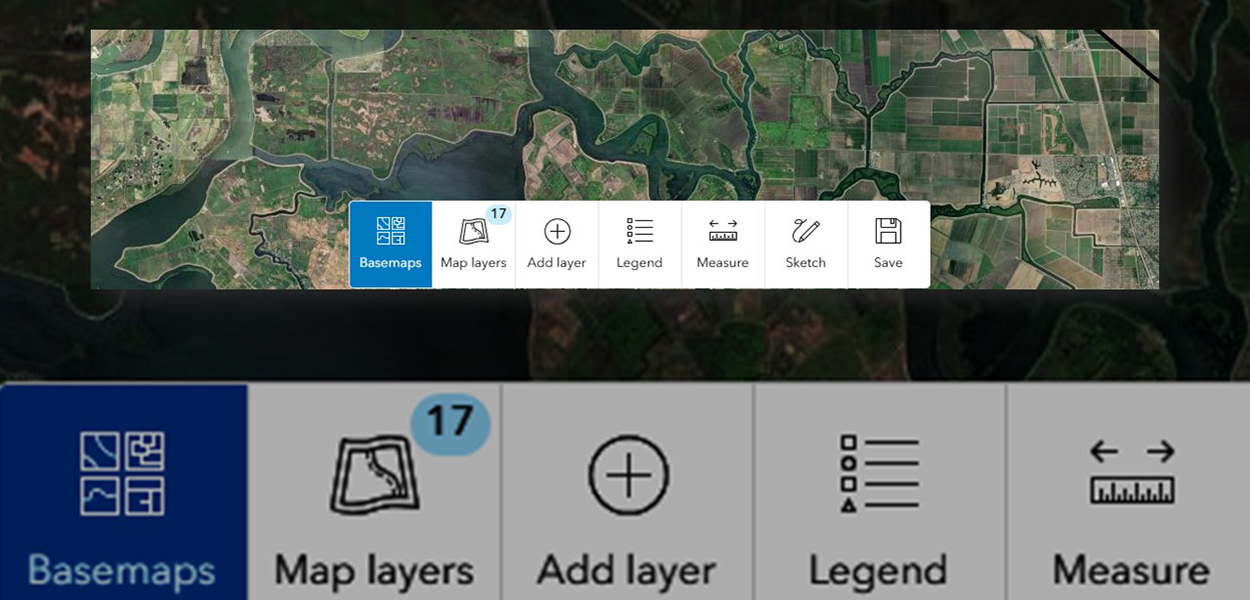
Two frequent questions we get from partners are where exactly the boundaries of the Delta are and if we can provide a map or data showing their extent. Delta Stewardship Council staff also regularly need to identify where projects or specific locations are in relation to the Delta. Council staff built an interactive online Delta atlas as a useful reference tool to make data accessible and more easily answer these types of questions. The atlas illustrates select boundaries, reference layers, and Delta Plan policies with a geographic component. Using the atlas, people can display this data, perform basic location searches, add placemarks and sketches, and export a map as a PDF or image.
“This tool provides a user-friendly way for our partners to visualize the geography of the Delta and represents our commitment to serving the public,” says Jeff Henderson, Deputy Executive Officer for Planning and Performance. “Making this available supports our work by translating policy into tools people can use without special training or software.”
Making Data Accessible
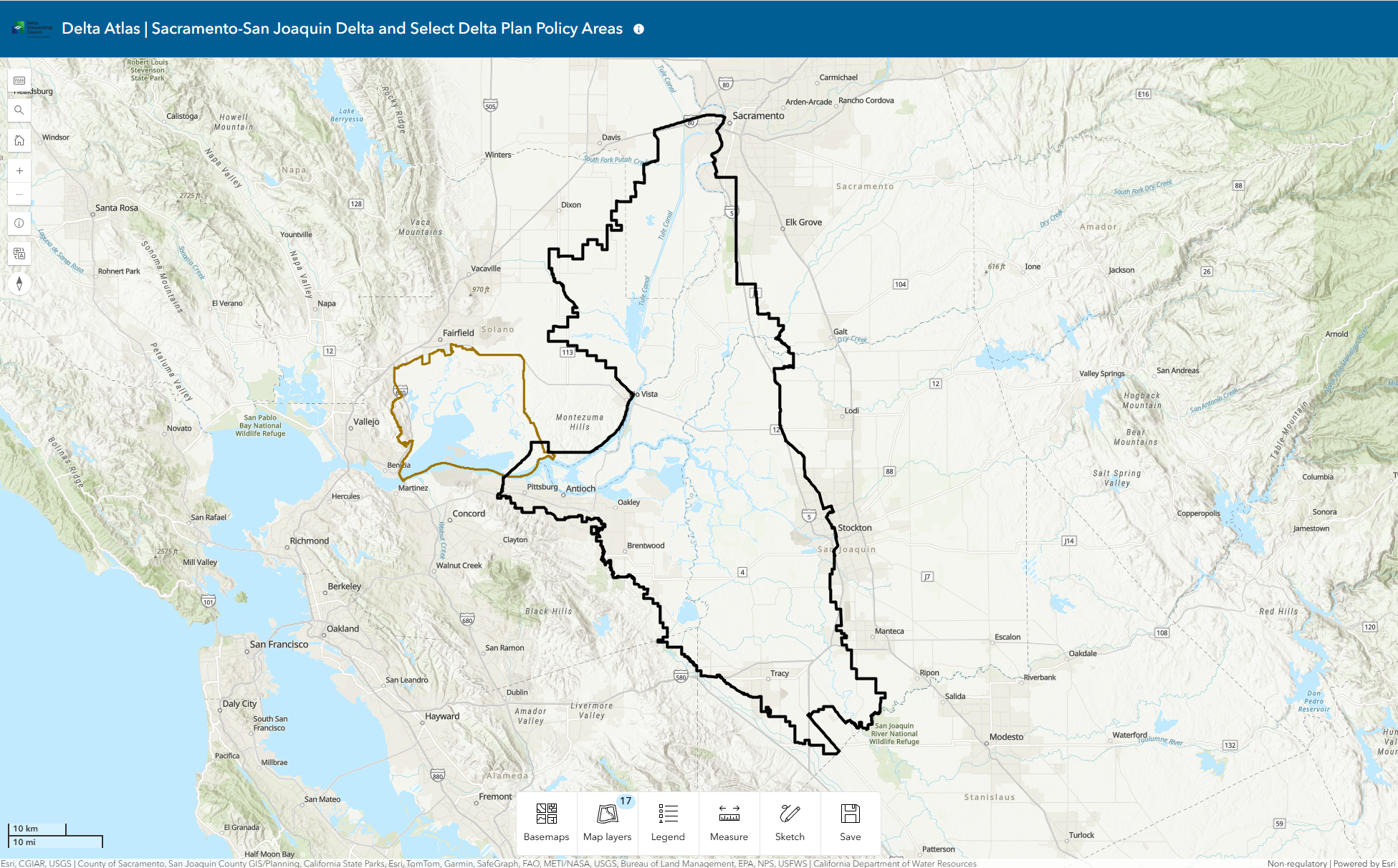
Delta Atlas interface
When the Delta Plan, which is the long-term management plan for the Delta, was adopted in 2013, it included a series of static maps. Many of these were in black and white and low resolution, making it difficult to see all the details for a given location. Over the last decade, technology has made it easy to create and share custom maps and data online. Providing an online atlas allows users to zoom in to see more detail as well as to export a static map – all in a web browser without the need for paid software. This approach aligns with the Council’s commitments to open data and serving the public (public participation plan, tribal and environmental justice).
Responsible Use and Next Steps
As noted above, the atlas was created to be a useful reference tool . However, it does not replace Delta Plan regulations or add new requirements. The tool is being provided as a user-friendly way to interact with this data. Please review relevant portions of the California Code of Regulations (and Delta Plan appendices) for regulatory applications. For more on Delta Plan regulatory policies, please visit our Delta Plan regulations web page.
The atlas is our first attempt to make select location data for the Delta more accessible to the public. We considered including a range of additional data sets, but have kept it focused for now to provide a more straightforward user interface. However, people can download additional data to make their own custom maps if desired. We hope to make improvements as we use the atlas ourselves and hear feedback from our partners and the community. For any questions or suggestions, please contact the Delta Stewardship Council.
About the Author

Dan Constable
Dan is an environmental program manager in the Council’s Planning and Performance Division. He leads the ecosystem restoration, land use, and science integration unit at the Council and is involved in a range of projects focused on these topics, including ecosystem restoration policy, climate change adaptation planning, and water resources. Prior to state government, Dan worked in transboundary water governance, biodiversity conservation, and policy across Southeast Asia. He previously worked in the nonprofit and private sectors. Dan holds a master’s degree in environmental management from Yale University and a B.S. in environmental resource sciences from the University of California, Davis.