
Managing and Preventing Invasive Species in Tomorrow’s Delta
June 10, 2026
By Elizabeth Brusati
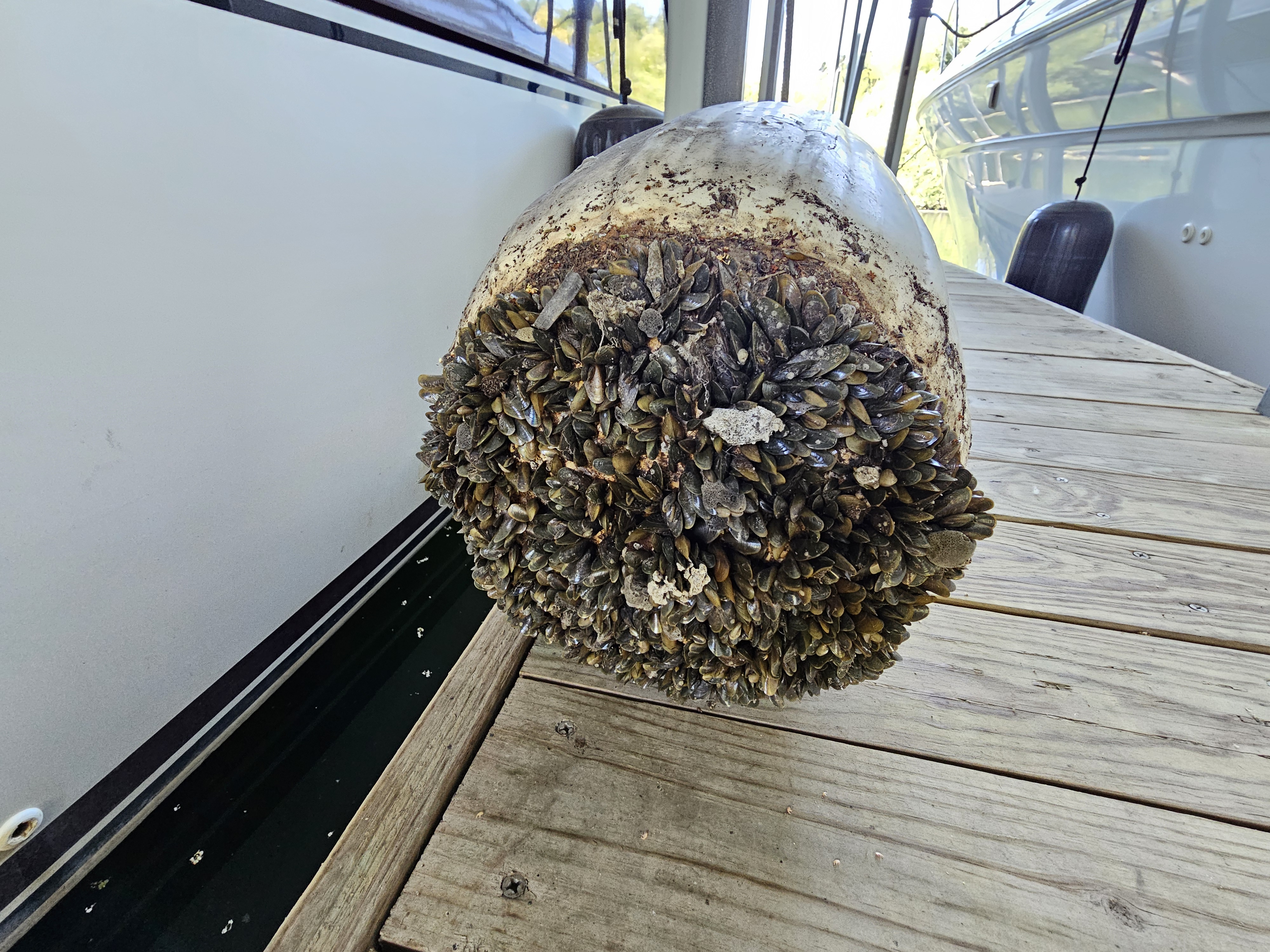
California depends on the health of the Sacramento-San Joaquin Delta’s ecosystem. It supports native fish, provides recreation, and helps move water across the state. Yet, that ecosystem is being reshaped. The San Francisco Bay Delta is one of the most invaded estuaries in the world, with nearly 200 non-native species already here and new ones arriving. This includes the destructive golden mussel, which has been spreading rapidly since its detection in the Delta in 2024. They clog pipelines, damage other water infrastructure, and may compete with fish for food.
No single agency can solve the invasive species problem alone; success depends on coordination among state, federal, local partners, and communities. For example, the Golden Mussel Task Force includes agencies as well as academic and non-governmental partners working together to address this newest threat.
What makes a species invasive?
It’s not native to a particular ecosystem, able to spread rapidly, and harmful to the environment, the economy, or human health. You may be familiar with longtime Delta invasive species like aquatic weeds or have seen recent headlines about nutria damaging marsh habitat and threatening levee protection. Most recently, golden mussels have gained attention by clogging water systems.
In recognition of California Invasive Species Action Week, June 6-14, we’re highlighting the Delta Interagency Invasive Species Coordination (DIISC) Team and its most recent Delta Invasive Species Symposium. The DIISC Team is co-led by the Delta Stewardship Council, the Sacramento-San Joaquin Delta Conservancy, the California Department of Fish and Wildlife, and the Department of Water Resources. California Invasive Species Action Week is an opportunity to learn about the impacts of invasive species on your local community, how to prevent their spread, and how to get involved in activities in your area.
Invasive species affect more than the environment and can cause:
- Harm to the Delta’s $50 billion agriculture industry,
- Damage to the infrastructure that supplies a portion of the water used by 27 million Californians,
- Hazardous conditions for recreational boating and commercial shipping, and
- Threats to many native species, including those that are threatened or endangered.
The Council has long recognized the need to improve management of invasive species in the Delta and Suisun Marsh. In 2021, the Delta Independent Science Board reviewed The Science of Non-native Species in a Dynamic Delta. The Council has funded research to improve early detection of invasive species, inform monitoring frameworks, and support collective action. Projects that qualify as a Covered Action under the Delta Plan must show how they address potential introductions of, or improved habitat conditions for, invasive species. Finally, the Science Action Agenda’s Management Need 5 highlights that acquiring and synthesizing knowledge on issues like invasive species that cause stress on the ecosystem is a priority research need for the Delta, as it can best position managers to take effective action.
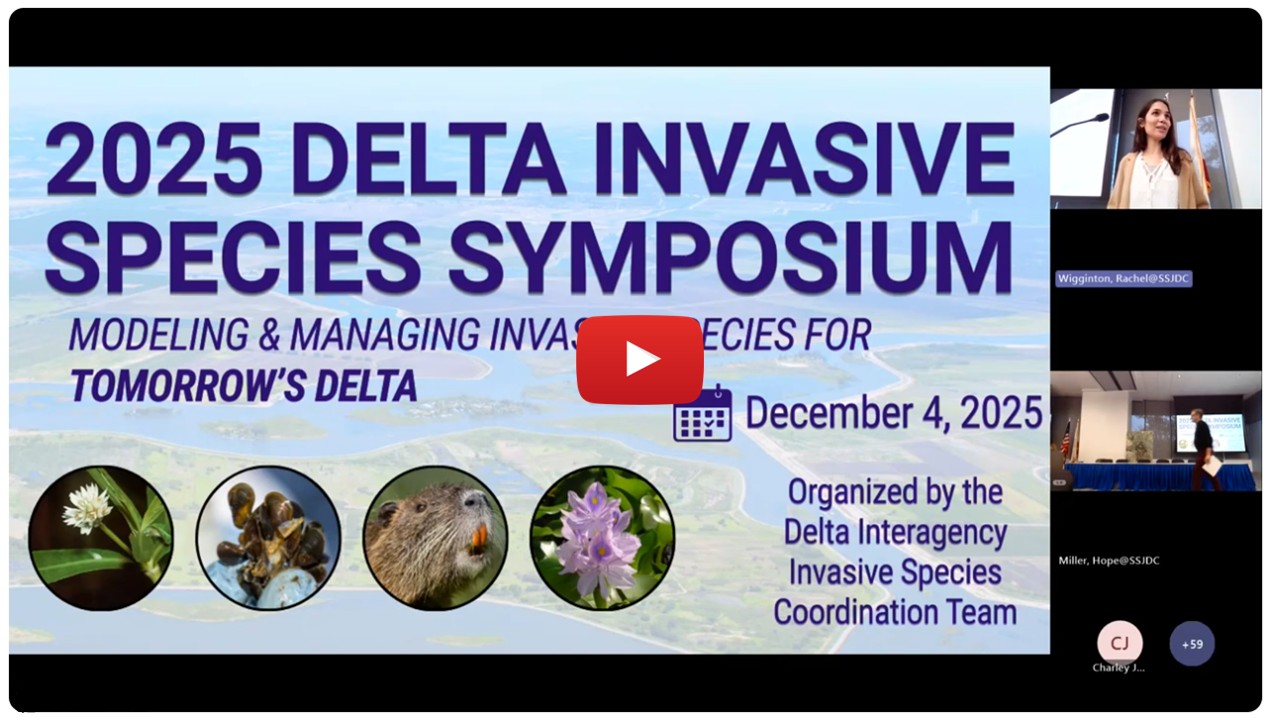
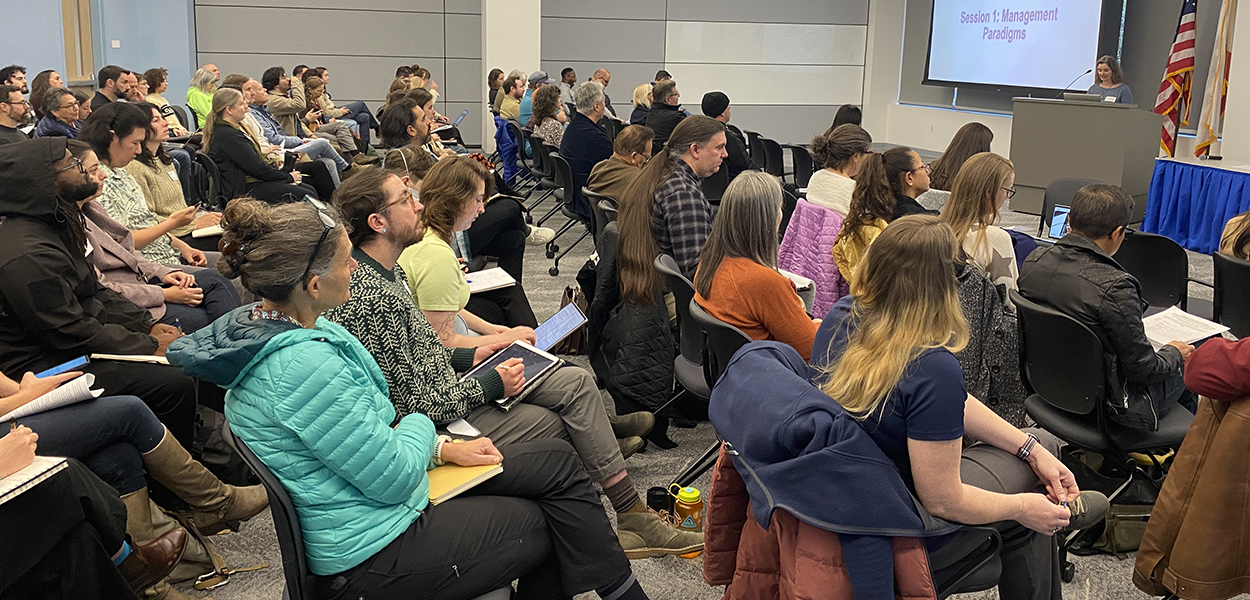
Every two years, presenters at the Delta Invasive Species Symposium share the latest information on research, tools, and management approaches. In December 2025, almost 300 attendees learned about “Modeling and Managing Invasive Species for Tomorrow’s Delta.” Throughout the symposium, speakers emphasized that collaboration among agencies, the private sector, and communities is essential to address this complex issue, especially amid intersecting challenges such as climate change. (View the recording of presentations on YouTube.)
In the opening session, California Natural Resource Agency’s Assistant Secretary for Biodiversity and Habitat, Madeline Drake, and Delta Lead Scientist, Dr. Lisamarie Windham-Myers, emphasized:
- Invasive species are a form of global change, and to strengthen biodiversity through programs like 30x30 (conserving 30% of California’s land and coastal waters by 2030), we must address them.
- There is still uncertainty about how to best manage or prevent their spread, but recent efforts have led to meaningful progress.
- Local communities have an important role to play as “eyes on the ground.”
The first set of presentations on “Management Paradigms” raised important questions about how to make invasive species management more effective, such as:
- How does invasive species management reflect our values? How should land managers choose whether to put resources towards resisting the changes from invasive species or adapting to a new normal?
- How could different scenarios in climate, ecosystem restoration, and water management affect the Delta’s salinity and the ability of invasive species to survive?
- How can agencies build trust and communicate better with local landowners?
The session on “Invasive Mussels in the Delta” described how agencies are working together to respond to the new threat of golden mussels in the region and prevent their spread to other areas. Ongoing research is addressing mussel biology and management to improve the response, including:
- Boats from the Delta travel to many other states, as far as Alaska, raising the risk that they could spread mussels.
- Tiny golden mussel larvae likely arrived at the Port of Stockton in ballast water (carried by cargo ships to help them stay balanced). California uses water treatment systems and water exchange to reduce the risk of invasions, but some risk remains.
- The Smithsonian Environmental Research Center is conducting research to predict other West Coast ports that could be at risk.
- The U.S. Army Corps of Engineers is testing anonymous cell phone data to predict how watercraft move between lakes.
- The California Department of Water Resources is testing control methods in State Water Project facilities, where golden mussels cause water quality equipment to malfunction and increase maintenance costs.
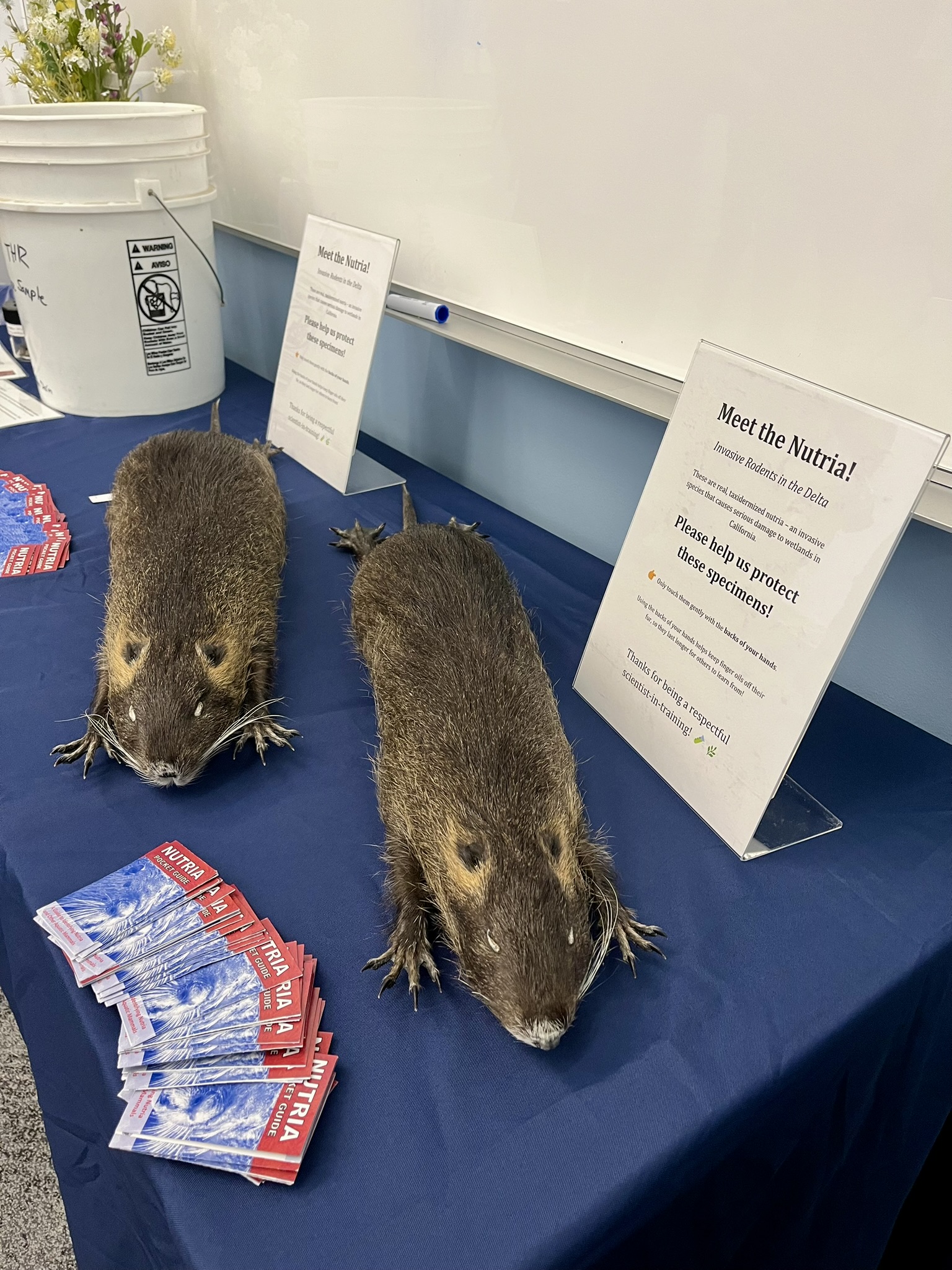
Brief “Lightning Talks” demonstrated the range of programs, tools, and research used for invasive species in the Delta, including:
- New species of river prawns and mitten crabs have been detected in the Delta.
- The Nutria Eradication Program is continuing efforts to eradicate this invasive rodent.
- Federal programs are funding important prevention activities such as watercraft inspections.
- Calflora can teach you about local native or invasive plants.
- Satellite imagery makes mapping and managing aquatic plants more effective.
- The U.S. Fish and Wildlife Service’s horizon scans identify potential invaders.
- Testing is underway on chemical control methods for the golden mussel.
The Symposium closed with a session on “New Tools for New Conditions,” describing research that may help us improve invasive species management as conditions continue to change:
- Research on alligatorweed will help predict its potential to spread and prioritize areas for control.
- Drought and aquatic weeds interact to change water quality and fish communities in the North Delta.
- Research by Department of Water Resources staff may show whether environmental DNA (DNA released into the environment by animals or plants) can be used with existing monitoring programs to track invasive species and identify new ones to allow faster response.
The Delta Invasive Species Symposium shows the range of actions that agencies and other organizations throughout California take to prevent, track, and control the spread of invasive species. But everyone can play a part in protecting our environment and economy by stopping the spread of invasive species! California Invasive Species Action Week is an opportunity to take local action on a statewide problem.
Wondering how you can help stop invasive species? Visit the California Department of Fish and Wildlife’s Invasive Species Program for the latest updates on golden mussels, information on actions to take, and how to report sightings of invasive species. Always follow the U.S. Fish and Wildlife Service’s advice to “Clean, Drain, and Dry” your watercraft, fishing gear, and hiking equipment to prevent the spread of invasive species! Join California Invasive Species Action Week events at locations statewide!
Thank you to the Symposium planning team: Anjali Shakya, Rachel Wigginton*, and Hope Miller (Sacramento-San Joaquin Delta Conservancy). Gina Darin (California Department of Water Resources), Thomas Jabusch (California Department of Fish and Wildlife). *Now at Delta Stewardship Council.
About the Author
Elizabeth Brusati is a senior environmental scientist and adaptive management liaison in the Adaptive Management Unit within the Council’s Delta Science Program. In this role, she supports science that will improve environmental decision-making for ecological restoration and other projects. She is also a co-lead for the Delta Interagency Invasive Species Coordination Team. Prior to joining the Council, she worked for the California Department of Fish and Wildlife and the nonprofit California Invasive Plant Council. Elizabeth holds a Bachelor of Science and a PhD from UC Davis, and a Master of Science from Texas A&M University.