
Bay-Delta Social Science Community of Practice
Following recommendations from the Delta Social Science Task Force May 2020 report, A Social Science Strategy for the Sacramento-San Joaquin, the Delta Stewardship Council is helping to develop a more collaborative and integrated network of social scientists and practitioners across the San Francisco Bay and Sacramento-San Joaquin Delta system.
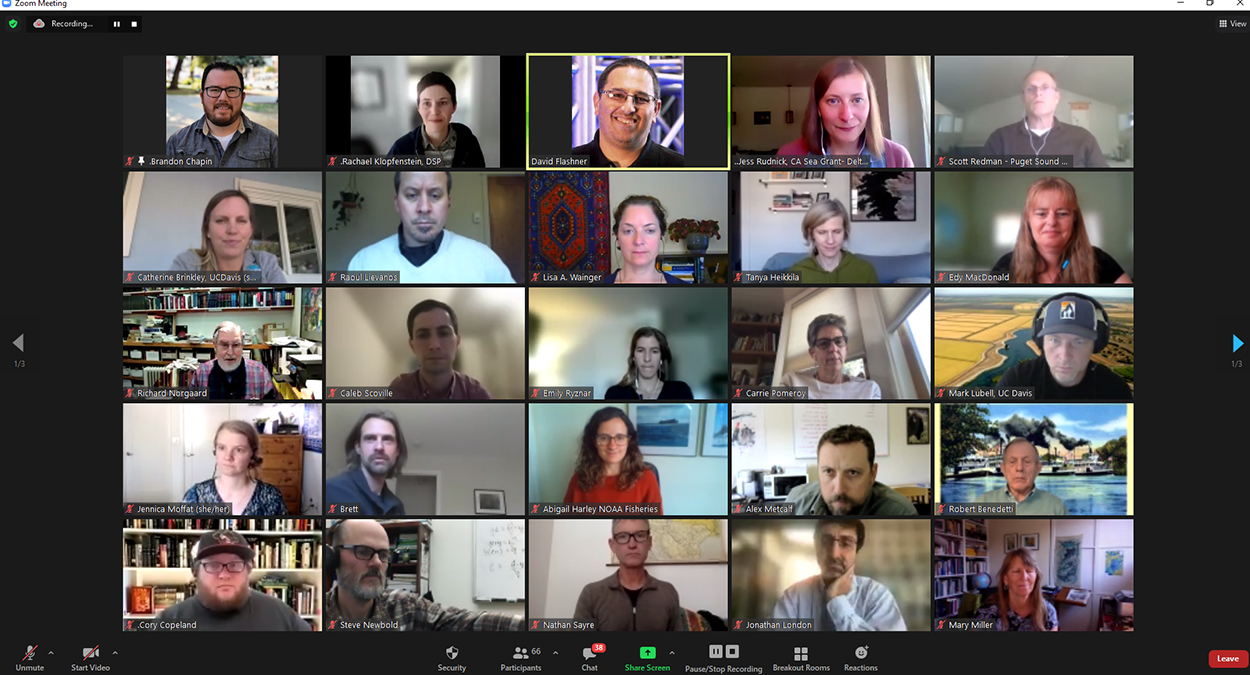
At the 2021 Bay-Delta Science Conference, hosted by the Council and U.S. Geological Survey, we launched the social science community of practice (CoP). The Council’s Social Science Integration Team produced a report to capture the key takeaways from the event, including who the CoP will involve and what social science activities and topics will be prioritized.
The purpose of the CoP is to bring together social science scholars, practitioners, and allies who are committed to advancing applicable and relevant research on the human dimensions of the Bay-Delta.
This community aims to:
- Facilitate collaborative social science research and interdisciplinary investigation,
- Provide opportunities for the social sciences to inform management and policy, and
- Advance our understandings of the estuary as a complex social-ecological system.
- Increase the body of social science research relevant to the region by conducting original data collection and investigation; developing and expanding conceptual frameworks linking the social and ecological dimensions of the estuary; and analyzing, reviewing, and synthesizing existing data and relevant comparative data
- Foster collaboration and co-production of social science by linking academia, agencies, tribes, non-governmental organizations, and communities across the region
- Communicate social science approaches, theories, tools, methods, and results to public, scientific, and governmental audiences to build literacy for the social sciences and understanding of the human dimensions of the region
- Inform management and policy with best available social science through frequent engagement and participation in decision-making venues across multiple scales in the region
- Provide mentorship and leadership opportunities for students and early career scholars and practitioners interested in working on the social sciences in this region
- Build the social capital needed to thoroughly integrate social sciences into a system that is heavily dominated by natural and biophysical scientific knowledge and approach, ultimately striving for a balanced social-ecological systems approach to management and policy
- Expand partnerships with other estuarine systems around the U.S. and internationally to learn, share and build improved understandings of social science integration and interdisciplinary science-based natural resource management decision-making
View the CoP’s Charter in PDF format.
- Diversity in network: recruit, attract, and support members from diverse backgrounds, career stages, geographies, disciplines, and institutions
- Equity, inclusion, and capacity building throughout all network activities: distribute opportunities for leadership, intellectual, and creative contributions between early, mid, and late-career members
- Boundary spanning: aim to build relevant, salient, and credible projects through co-production; foster collaboration on projects by engaging members from across academia, government, non-governmental organizations, and practitioners working in communities; prioritize accessibility in science communication and output products
CoP members are based in academia, government agencies, non-governmental organizations, and the private sector. Members opt-in to be included in our online CoP directory to facilitate easier connection and collaboration.
| Name (First Last) |
Affiliation (Organization, Department) |
Expertise/ Discipline | Areas of Focus | Links to professional platforms | |
|---|---|---|---|---|---|
| Liat Perlin Wilde | lwilde@pointblue.org | Point Blue Conservation Science | Conservation Social Science | ||
| Julie Gonzales | gonzalez@sfsu.edu | San Francisco State University | |||
| Sasha Harris-Lovett | sasha.harris-lovett@sfestuary.org | San Francisco Estuary Partnership | |||
| Jesse Engebretson | jengebretson@csuchico.edu | CSU Chico | |||
| Rosemary Kosaka | rosemary.kosaka@noaa.gov | NOAA Southwest Fisheries Science Center | Natural resource economics & other social science methods; program development & evaluation; mentorship & early career development | Nonmarket valuation methods including ocean & coastal recreation; seafood markets & preferences; ecosystem services | https://www.fisheries.noaa.gov/contact/rosemary-kosaka, https://www.linkedin.com/in/rosemary-kosaka/ |
| Emmanuel Asinas | emmanuel.asinas@water.ca.gov | Department of Water Resources | Natural resources and environmental economics, specializing in water resources economics to integrate economic analysis, climate resilience, and equity in statewide water management and policy | Economic modeling and benefit cost analysis for multi benefit water projects Groundwater overdraft, land subsidence, drought, flood, and climate impact analysis Economic guidelines for watershed management, drought planning, and aquifer recharge Equity and distributional analysis in statewide water programs and decision making |
https://water.ca.gov/ |
| Mark Lubell | mnlubell@ucdavis.edu | Department of Environmental Science and Policy, UC Davis | Environmental Policy and Governance | Water, Agriculture, Climate Change | https://environmentalpolicy.ucdavis.edu/ |
| Lindsay Correa | lindsay.correa@water.ca.gov | California Department of Water Resources | Environmental Science and Policy | Climate Resilience and Organizational Science | https://water.ca.gov/ |
| Kyle Clifton | cliftonk@oregonstate.edu | Oregon State University; Dept of Fisheries, Wildlife, & Conservation Sciences | Human dimensions of natural resource management | Human wellbeing and conservation | |
| Alex Thomsen | alexandra.thomsen@sfestuary.org | San Francisco Estuary Partnership | Environmental Science | Human dimensions of wetlands | https://www.linkedin.com/in/alexandra-s-thomsen |
| Morgan Gilbert | morgan.gilbert@wildlife.ca.gov | California Department of Fish and Wildlife | Fish Ecology | Early life history of fish, Longfin and Delta Smelt | |
| Tara Pozzi | Tpozzi@ucsd.edu | CA Sea Grant | Environmental Policy, Computational Social Science, Governance | Environmental governance, community resilience, climate adaptation, human wellbeing | Tarapozzi.github.io |
| Adina Paytan | apaytan@ucsc.edu | UCSC | Wetland Biogeochemistry | Encouraging collaboratio between social and ntural scientists focus on wetland biogeochemistry | https://paytanlab.ucsc.edu/ |
| Becca VanArnam | rlvanarnam@ucdavis.edu | UC Davis | Environmental Science Education | Community and Citizen Science, Environmental Justice, Multilingual Learners, Culturally Informed Pedagogy, Environmental Stewarship | https://www.linkedin.com/in/rebecca-vanarnam-547884169/ |
For more information or interested in joining the CoP, email Tara Pozzi at tpozzi@ucsd.edu.
Community of Practice members meet quarterly. To join these meetings, please email Beck Barger at Beck.Barger@deltacouncil.ca.gov.
Learn about other social science-related events on the Council on the social science web page.
Advancing Interdisciplinary Research | 2022
This two-part event included a training and workshop on interdisciplinary research in the Sacramento-San Joaquin Delta. The event aimed to (1) share knowledge across the social and natural science communities, (2) provide examples of interdisciplinary research that could advance useable science in the Delta, and (3) overcome barriers to interdisciplinary research by spurring new relationships and exploring innovative solutions to the Delta’s entrenched challenges. Training and workshop attendees were a diverse audience of over 80 participants from agencies and academia.
- Event Summary
- Agenda
- Training Recording
- Workshop Recording
- List of Delta groups and forums where collaboration occurs across entities, disciplines, and topics.
Human Dimensions research in Delta Environments Workshop | 2019
This workshop showcased how social science research addresses management challenges faced by the Delta Stewardship Council, stakeholders, and more. Workshop materials available online.
Learn about specific Council projects on the social science web page.
- HD.gov: USGS’ federal effort to integrate human dimensions into natural resource work across federal agencies
- MarineSocSci: A network linking organizations and individuals integrating social sciences into marine and coastal natural resource management
- Wondering what is a “community of practice”? Read this information sheet by Mississippi-Alabama Sea Grant and the National Oceanic and Atmospheric Administration
- Training
- Case Studies
- NOAA Social Coast Forum presentations (2022)
- Edy McDonald presentation in CA Dept. of Fish & Wildlife Conservation Lecture Series with examples of behavioral science informing conservation efforts in New Zealand (2019)
- Social Science in the Delta
- The Council’s Social Science Task Force Report (2020)
- Delta Independent Science Board’s Review of Research on the Sacramento-San Joaquin Delta as an Evolving Place (2017)
- Lubell et al. (2022) Governing Science: Learning and Adaptive Management in the California Delta. Pre-print available at https://dx.doi.org/10.2139/ssrn.4175099
To learn more about the CoP or to get involved, please contact Tara Pozzi at tpozzi@ucsd.edu.